When abrasive solids move through a pipeline, ordinary rubber can wear faster than expected. Abrasion Resistant Rubber Hose is designed for this punishment. Its inner tube uses wear-resistant rubber compounds, often with reinforcement for pressure and flexibility. The result is a hose that handles sand, gravel, slurry, cement, minerals, and other harsh materials. It is not simply a thicker hose. Compound quality, wall design, bend radius, temperature range, and operating pressure all matter. In practice, a hose may look healthy outside while its inner lining is thinning. That hidden damage can cause leaks, downtime, or sudden replacement.
This guide explains what Abrasion Resistant Rubber Hose is and where it is used. Common settings include mining plants, dredging operations, quarries, concrete production, steel facilities, and wastewater handling. At a quarry, a hose may carry wet stone slurry beneath vibrating equipment. The correct selection depends on particle size, concentration, velocity, temperature, and routing. Consult manufacturer data and inspect connections regularly. Field experience also shows that poor alignment can defeat an excellent hose. No hose lasts forever. That point is easy to forget. Operators should record service conditions, check outer damage, and replace hoses before failure becomes expensive. Product claims deserve careful review, because “abrasion resistant” does not mean suitable for every chemical or pressure level. Reliable decisions combine tested specifications, trained inspection, and honest attention to actual working conditions. This article offers a practical starting point, not a substitute for application engineering.
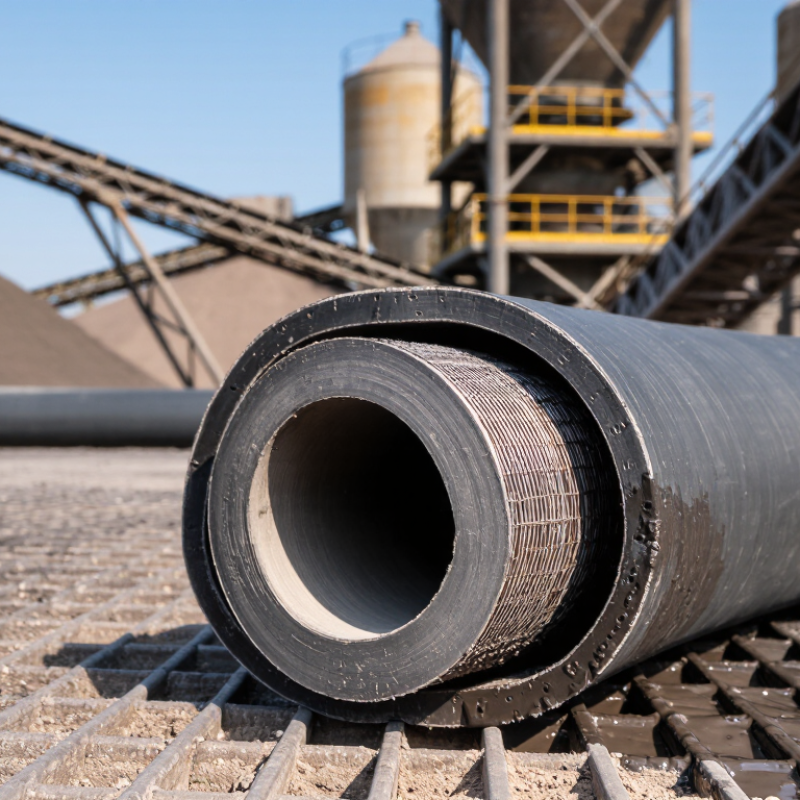
Abrasion-resistant rubber hose is a flexible pipeline designed to carry abrasive materials. These materials include sand, gravel, ore, cement, and mineral slurry. Its inner tube uses wear-resistant rubber compounds, often supported by textile or steel reinforcement. The rubber absorbs impact from sharp particles. It also limits surface cutting during repeated flow. The U.S. Geological Survey’s Mineral Commodity Summaries 2024 reported approximately 1.9 billion metric tons of crushed stone production in the United States in 2023. That volume shows why dependable wear protection matters in aggregate handling.
Its core characteristic is controlled material loss. ISO 4649 measures rubber abrasion through volume loss after contact with an abrasive surface. Lower loss usually indicates better resistance. However, the term is not absolute. A hose may resist rubbing but fail under high pressure, heat, twisting, or chemical exposure. Particle size and velocity matter too. In field inspections, technicians often find damage near bends, couplings, and poorly supported sections. The result can be surprising. Better rubber alone cannot correct poor routing or excessive flow speed.
Tips: Match the hose to the material, pressure, temperature, and particle size. Check wall thickness regularly, especially near bends. Do not judge service life from appearance alone. A slightly worn surface may be safe, while a hidden reinforcement cut may require immediate replacement. ASTM D5963 and ISO 4649 test results can support comparison, but real operating conditions still need honest review.
Abrasion resistant rubber hoses are designed to transport solid particles, slurries, and other wear-producing materials. Particle size is one important factor when evaluating abrasion exposure, although material hardness, shape, concentration, velocity, and hose lining thickness must also be considered.
The chart uses common ISO 14688 particle-size boundaries: clay is below 0.002 mm, silt ranges up to 0.063 mm, sand up to 2 mm, gravel up to 63 mm, and cobbles up to 200 mm. Larger and harder particles generally require more durable hose linings and stronger reinforcement.
Abrasion-resistant rubber hose is built for harsh service, where sand, gravel, slurry, or mineral particles rub against the inner wall. Its construction starts with a thick rubber tube. This tube usually contains a specially compounded rubber layer with high resistance to cutting, tearing, and repeated friction. The exact compound depends on temperature, material hardness, and flow speed. A harder lining is not always better. It may resist wear but reduce flexibility.
The hose body is formed around reinforcement layers made from textile cords, wire, or both. These layers control pressure expansion and help the hose bend without collapsing. Spiral reinforcement suits demanding movement, while woven fabric can support lighter applications. Small design choices matter. The outer cover protects the structure from moisture, sunlight, impact, and contact with nearby equipment. In some designs, an extra rubber layer is added around bends or connection points. Those areas often fail first.
During manufacturing, heat and pressure cure the rubber into a bonded structure. Proper curing prevents separation between the lining, reinforcement, and cover. Inspectors may check wall thickness, hardness, flexibility, and pressure performance. In field inspections, uneven bulges, exposed cords, and stiff bends are warning signs. I have seen hoses selected by pressure rating alone, which is a costly mistake. Abrasion also depends on particle shape, concentration, and flow turbulence. These hoses are commonly installed in dredging systems, mining plants, concrete transfer lines, and bulk-material handling equipment. The construction must match the actual service, not just the catalog description.
| Data Dimension | Typical Construction or Specification | Why It Matters | Common Uses |
|---|---|---|---|
| Primary Function | Designed to convey abrasive solids, slurries, powders, or granular materials while resisting internal wear. | Reduces hose replacement frequency and helps limit leakage caused by wall erosion. | Mining, mineral processing, dredging, cement handling, and bulk-material transfer. |
| Tube Material | A thick, wear-resistant rubber tube, commonly based on natural rubber or synthetic rubber compounds selected for the conveyed material. | The tube is the main barrier against particle impact, sliding abrasion, and slurry erosion. | Sand, gravel, ore, coal, ash, cement, limestone, and mineral slurry transfer. |
| Typical Tube Thickness | Often approximately 6–20 mm for abrasion-resistant hose, depending on bore size, pressure, material concentration, and service conditions. | A thicker wear layer provides more service allowance before the hose reaches its minimum safe wall thickness. | Heavy-duty slurry lines, chute connections, and discharge lines exposed to concentrated solids. |
| Reinforcement | Textile plies, steel wire, or a combination of reinforcement layers, depending on pressure and flexibility requirements. | Provides pressure resistance, dimensional stability, kink resistance, and mechanical strength. | Pump discharge, pressure slurry service, articulated connections, and long transfer runs. |
| Cover Material | An external rubber cover formulated for resistance to weathering, ozone, oil exposure, heat, or mechanical damage as required. | Protects reinforcement from moisture, sunlight, impact, and the surrounding operating environment. | Outdoor mining systems, aggregate plants, construction sites, and industrial processing areas. |
| Abrasion Mechanisms | The hose must withstand sliding abrasion, impact abrasion, cutting, gouging, and erosion from high-velocity particles. | Different materials and flow conditions wear rubber in different ways, so compound selection must match the application. | Sharp crushed rock, fine sand slurry, coal particles, metal-containing concentrates, and ceramic powders. |
| Pressure Capability | Common working-pressure ranges are approximately 10–40 bar, although the actual rating depends on construction, diameter, temperature, and reinforcement. | The hose must safely withstand operating pressure, surges, vacuum conditions, and pump-related fluctuations. | Slurry pumps, mineral processing circuits, dredging discharge, and pressurized powder conveying. |
| Temperature Range | Many general-purpose designs operate around −30°C to +80°C; specialized compounds may support different temperatures. | Temperature affects rubber flexibility, strength, aging, and resistance to the conveyed material. | Ambient-temperature slurry, warm process water, cement handling, and selected industrial powder applications. |
| Bore Diameter | Available sizes commonly range from approximately 25 mm to more than 300 mm inside diameter, subject to the hose design. | Correct bore sizing helps control flow velocity, pressure loss, blockage risk, and wear rate. | Small pump connections, large-diameter dredging lines, aggregate transfer, and plant piping connections. |
| Flexibility | Flexible rubber construction can accommodate movement and vibration; thicker walls and heavier reinforcement generally reduce flexibility. | Flexibility simplifies routing and helps isolate vibration between fixed equipment and moving components. | Pump-to-pipe connections, loading arms, vibrating equipment, and mobile processing machinery. |
| Connection Methods | Typically installed with flanges, grooved couplings, clamps, threaded adapters, or other application-specific end fittings. | A properly selected connection reduces leakage, turbulence, joint stress, and premature wear near the hose ends. | Processing plants, slurry pipelines, transfer stations, and equipment inlet or discharge points. |
| Typical Conveyed Media | Water-based slurries, sand, gravel, coal, fly ash, cement, ore concentrates, tailings, and other non-corrosive abrasive solids. | Media density, particle size, sharpness, concentration, and flow velocity strongly influence hose life. | Mining, quarrying, dredging, construction, power generation, and cement production. |
| Selection Priorities | Consider inner diameter, working pressure, temperature, vacuum requirement, abrasion severity, chemical compatibility, bend radius, and connection type. | Matching the hose design to the complete operating profile improves safety, efficiency, and service life. | All abrasive-material handling systems, especially where unplanned shutdowns are costly. |
| Inspection Indicators | Check for cover cuts, bulges, exposed reinforcement, leakage, kinks, flattened sections, unusual vibration, and excessive wall loss. | Routine inspection can identify deterioration before a rupture or major material spill occurs. | Pressurized slurry lines, suspended hoses, high-flow transfer points, and hard-to-access installations. |
Note: Performance values are typical industry ranges and can vary with hose construction, diameter, reinforcement, temperature, pressure, conveyed material, and installation conditions.
Abrasion-resistant rubber hose carries sand, gravel, cement, or mineral slurry through demanding systems. Its inner tube uses a rubber compound designed to resist cutting and material loss. In practice, hose life depends on more than rubber hardness. Flow speed, particle shape, temperature, pressure, and bending also matter.
Abrasion resistance is commonly measured by a standardized test that records rubber volume loss after rubbing against an abrasive surface. Lower volume loss usually indicates better resistance. Test results must match the working condition. Dry sand and sharp crushed stone can damage a hose differently. Shore hardness helps describe the rubber, but it does not predict service life alone. A field trial may reveal more.
Measure carefully. Keep records.
Maintenance starts with visual inspection. Look for exposed reinforcement, blisters, deep cuts, and thinning near bends. A pale, polished area may show internal wear before leakage appears. Check clamps, supports, and alignment because twisting creates uneven abrasion. Flush abrasive residue when the process allows it. Avoid dragging the hose across concrete. Rotate sections periodically, but only when the hose design permits it. Replacement timing is not always obvious. I have seen hoses removed too early and others kept too long. That judgment should be based on measured wall thickness, operating history, and the risk of sudden failure.
Abrasion resistant rubber hose carries sand, rock, cement, or mineral slurry through demanding systems. Its thick rubber tube absorbs repeated impact from sharp particles. Reinforced layers also help resist pressure, bending, and vibration.
Mining is a major application. The USGS Mineral Commodity Summaries 2024 reported global copper mine production of about 22 million metric tons in 2023. This volume creates continuous slurry movement in concentrators, tailings lines, and dewatering systems. Dredging uses similar hoses for sand and silt. The USGS also estimated United States construction sand and gravel production at 960 million metric tons in 2023. That figure shows why hose durability matters in aggregate handling. Cement plants, steel mills, power stations, and mineral processing sites face comparable wear. A hose may look sound outside. Its inner tube can still be dangerously thin.
Tips: Match the hose to particle size, slurry density, temperature, and operating pressure. Use a larger diameter when possible, because lower flow speed can reduce wear. Inspect bends, couplings, and outer blisters during scheduled shutdowns. Rotate the hose when the design allows it. Do not rely only on service life tables; actual wear depends on angle, moisture, and pump behavior. This part is often underestimated. Keep inspection records with pressure readings and replacement dates, following guidance from the Rubber Manufacturers Association and site safety procedures.
Abrasion-resistant rubber hose selection begins with the material being transported. Identify particle size, hardness, concentration, temperature, and flow speed. Sand slurry needs a thicker inner tube than soft powder. Check working pressure, including sudden pressure surges. Do not rely on appearance alone. A hose may look strong but still have an unsuitable lining. Confirm the minimum bend radius, reinforcement type, and coupling compatibility before ordering. I have seen premature failures caused by mismatched ends, not worn rubber.
Installation requires careful alignment. Keep the hose within its stated bend radius. Avoid twisting it during connection. Support long sections, especially near heavy couplings. Use suitable clamps, but never crush the tube. Protect it from sharp edges, hot surfaces, and repeated contact with steel frames. Pressure-test the assembled line in a controlled area. Watch every joint. Small installation errors can create serious wear points.
Maintenance should match the operating schedule. Inspect the hose after demanding shifts, checking bulges, cuts, exposed reinforcement, flattened areas, and leakage around couplings. Measure wall thickness at known impact zones and record the readings. Replace the hose before the inner tube becomes dangerously thin. A simple inspection log improves decisions, although it is easy to neglect during busy production periods. Reduce drop height and sudden flow changes where possible. Store spare hoses clean, dry, and away from sunlight, oils, and sharp objects.