In 2026, rmc concrete is no longer judged only by compressive strength. Contractors also examine placement speed, carbon intensity, durability, and project risk. The strongest mix on paper may still fail beside a congested reinforcement cage or during a hot afternoon pour.
The Global Cement and Concrete Association reports that concrete remains the world’s most widely used construction material, with billions of cubic metres placed annually. The International Energy Agency also links cement production with roughly 7% of global energy-related and process carbon dioxide emissions. These figures explain why low-carbon, high-performance, self-compacting, fiber-reinforced, and conventional ready-mix types deserve closer comparison. Market reports from Grand View Research and Research and Markets indicate continued growth in ready-mix demand, especially across infrastructure, housing, and commercial construction. Their forecasts differ, however. Regional definitions and reporting methods are not perfectly aligned.
Practical experience still matters. A mix design must suit the pump, haul distance, weather, curing plan, and finishing crew. Adam M. Neville, a leading concrete technology author, wrote, “Concrete is the most widely used construction material in the world.” His observation remains relevant to every RMC decision. Popularity does not guarantee suitability.
This guide compares the top rmc concrete types expected to shape 2026 projects. It considers performance, application, sustainability, cost, and quality control. Some rankings may change by region. That is a limitation worth admitting. The best concrete type is often the one that performs reliably at the actual jobsite, not the one with the most impressive laboratory data.
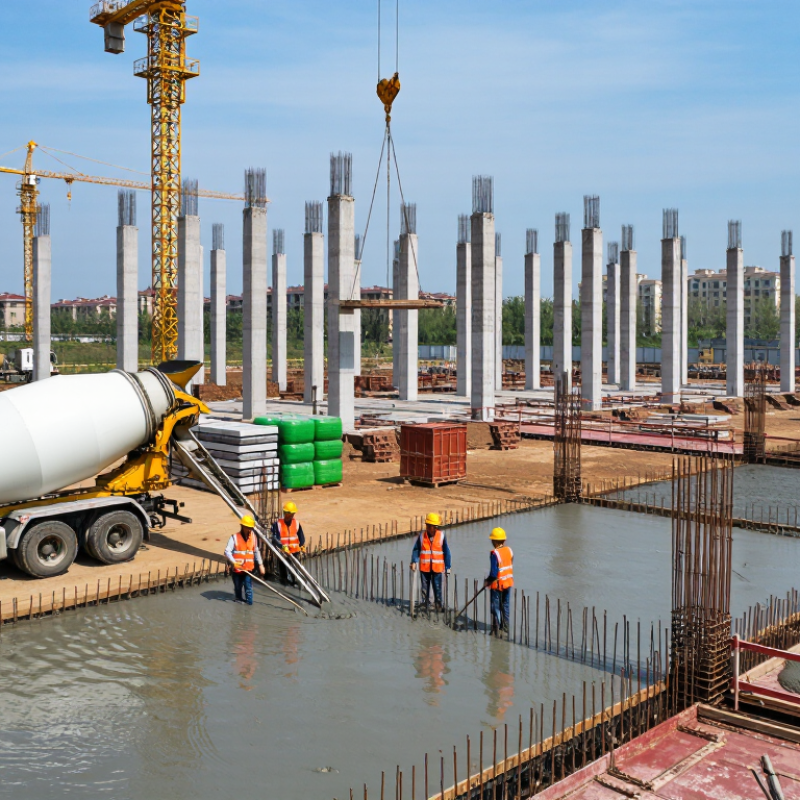
Ready-mixed concrete (RMC) is concrete batched at a controlled plant, then delivered by truck to a jobsite. Its mix usually combines cement, water, aggregates, and chemical admixtures. ASTM C94/C94M provides key requirements for production and delivery.
The type matters because each project faces different loads, climates, and placement limits.
Concrete remains the world’s most widely used construction material, with annual use estimated at about 14 billion cubic metres by the Global Cement and Concrete Association. However, volume alone does not prove sustainability. The International Energy Agency estimates cement production causes roughly 7% of global energy-related and process emissions. Mix selection therefore matters in 2026.
A practical specification should examine strength, slump, exposure class, curing conditions, and delivery distance. A low-carbon mix can perform poorly if it arrives late or cures badly. That detail is easy to overlook.
Performance data should come from trial batches, test cylinders, and certified quality records. Reports from the National Ready Mixed Concrete Association emphasize production control and testing, but field conditions still introduce uncertainty. No single RMC type is best for every structure.
What Are the Top RMC Concrete Types in 2026?
In 2026, RMC concrete is classified by performance, ingredients, and intended placement. The most practical starting point is specified compressive strength, measured after 28 days. Common categories include normal-strength, high-strength, and ultra-high-strength concrete. A higher grade is not automatically better. It can increase cost and make placing more sensitive.
Mixes are also separated by workability, usually described through slump or flow. A stiff mix suits some pavements, while a flowing mix helps congested reinforcement. Aggregate size creates another clear distinction. Small aggregate supports thin sections and dense steel cages. Larger aggregate can reduce paste demand in thick foundations. RMC plants may also supply lightweight, fiber-reinforced, self-compacting, and rapid-strength mixes. Each type changes pumping pressure, finishing time, and curing needs.
Exposure conditions refine the classification further. Concrete for marine air, freeze-thaw cycles, or industrial chemicals needs different durability controls. Water-cement ratio, cementitious materials, air content, and admixtures become critical selection points. From site experience, slump loss during a hot afternoon is easy to underestimate. A truck can arrive workable, then stiffen before final placement. That is why approved mix tickets, delivery timing, testing, and curing records matter. Classification is not perfectly uniform across regions. Specifications should match local standards and the actual structure.
| RMC Concrete Type | Primary Classification | Typical 28-Day Compressive Strength | Typical Fresh-Concrete Characteristics | Approximate Density | Common Applications | Defining Benefit |
|---|---|---|---|---|---|---|
| Normal-Strength Concrete | Strength-based classification | 20–40 MPa | Conventional workability; slump commonly about 75–125 mm, depending on the mix and placement method | Approximately 2,200–2,400 kg/m³ | Residential foundations, slabs, pavements, walls, and general building work | Versatile and economical for routine structural and non-structural construction |
| High-Strength Concrete | Strength-based classification | Typically above 50 MPa | Low water-to-cementitious-material ratio; often requires high-range water-reducing admixtures | Approximately 2,300–2,500 kg/m³ | High-rise columns, heavily loaded beams, bridges, and long-span structures | Supports higher loads and can reduce member size and congestion |
| High-Performance Concrete | Performance-based classification | Commonly 40–80 MPa, although the range varies by project specification | Designed for a combination of strength, durability, low permeability, workability, or dimensional stability | Approximately 2,300–2,500 kg/m³ | Bridges, marine structures, tunnels, industrial floors, and severe-exposure infrastructure | Delivers several specified performance properties rather than strength alone |
| Self-Compacting Concrete | Workability-based classification | Approximately 25–70 MPa, depending on the structural design | Highly flowable; spreads under its own weight and is generally assessed by slump-flow testing rather than ordinary slump alone | Approximately 2,200–2,450 kg/m³ | Congested reinforcement, complex formwork, precast elements, and architectural concrete | Fills formwork with little or no mechanical vibration when properly designed |
| Lightweight Aggregate Concrete | Density-based classification | Approximately 15–40 MPa for many structural and semi-structural mixes | May require moisture-controlled lightweight aggregates; workability is adjusted with admixtures and mix proportions | Approximately 1,400–2,000 kg/m³ | Floor systems, roofs, precast panels, bridge decks, and structures where dead-load reduction is important | Reduces self-weight and may improve thermal performance |
| Heavyweight Concrete | Density-based classification | Approximately 20–60 MPa, depending on the design requirements | Uses dense aggregates; segregation control and careful handling are important | Usually above 2,600 kg/m³ | Radiation-shielding walls, medical facilities, counterweights, and specialized security structures | Provides high mass for radiation attenuation or ballast applications |
| Fiber-Reinforced Concrete | Reinforcement-based classification | Commonly 20–60 MPa in structural and pavement applications | Contains steel, synthetic, glass, or natural fibers; fresh workability depends on fiber type and dosage | Approximately 2,200–2,500 kg/m³ | Industrial floors, pavements, precast products, tunnel linings, and shotcrete | Improves crack control, toughness, impact resistance, or post-cracking capacity |
| Rapid-Hardening Concrete | Setting and strength-development classification | Project-specific; may achieve a high proportion of design strength at early ages | Uses fast-reacting cementitious materials or accelerating admixtures; requires efficient placement and finishing | Approximately 2,200–2,450 kg/m³ | Emergency repairs, road openings, airport maintenance, precast production, and time-sensitive construction | Allows earlier removal of forms or return to service when properly specified |
| Waterproof or Low-Permeability Concrete | Durability and permeability-based classification | Commonly 30–60 MPa, depending on exposure and structural requirements | Low water-to-cementitious-material ratio; may include supplementary cementitious materials and permeability-reducing admixtures | Approximately 2,200–2,450 kg/m³ | Basements, water-retaining structures, tunnels, marine works, and underground infrastructure | Limits water penetration and improves resistance to aggressive exposure |
Standard ready-mixed concrete remains a practical choice for everyday construction in 2026. It suits foundations, floor slabs, columns, walkways, and small retaining walls. The plant batches cement, aggregates, water, and approved admixtures under controlled conditions. This usually gives more consistent workability than mixing materials beside the site.
A typical delivery arrives by transit mixer and should be placed without unnecessary delay. Before pouring, crews should check the delivery ticket, mix designation, quantity, and requested slump. The formwork must be stable, clean, and properly supported. Reinforcement needs correct spacing and adequate cover. Small details matter here. A misplaced bar can reduce durability.
Standard RMC is not a universal recipe. Strength requirements depend on structural loads, exposure, local codes, and curing conditions. A qualified engineer should select the appropriate mix class. On site, workers should avoid adding uncontrolled water because it can weaken the hardened concrete. Concrete should be compacted carefully, then protected from rapid moisture loss. In hot or windy weather, curing may need extra attention.
In practice, even a well-designed mix can perform poorly when access is blocked or placement is rushed. I have seen avoidable surface defects begin with late preparation, not defective concrete. That is why the pour sequence, pump position, traffic route, and curing materials deserve review before the truck arrives.
High-performance RMC concrete supports projects where ordinary mixes may struggle. High-strength concrete suits tall columns, transfer beams, and heavily loaded floors. Fiber-reinforced concrete helps control cracking in slabs, tunnels, and industrial pavements. Self-compacting concrete flows around dense reinforcement without mechanical vibration. It is useful in narrow forms and complex structures.
A reliable mix begins with the project environment. Low-permeability concrete protects foundations exposed to groundwater, salts, and repeated wetting. Rapid-setting mixes can shorten repair closures, but they demand disciplined placement. Site teams should check slump, concrete temperature, air content, and delivery time. Fresh samples should be taken for strength testing. Small details matter.
The water-cement ratio remains critical. Excess water may improve flow temporarily, yet it can reduce durability and strength. Modern admixtures offer better workability without adding water. I have seen promising pours weakened by poor curing, delayed finishing, or congested reinforcement. The mix was not always the problem. Curing should begin promptly, using suitable moisture protection and temperature control. Engineers should also review batch records and adjust the mix after trial pours. No formulation is perfect for every site. Wetter weather, traffic delays, or unexpected formwork conditions can change performance. A practical specification leaves room for measured correction, not guesswork.
Choosing ready-mix concrete (RMC) starts with the structure, not the product label. Review the design strength, exposure class, placement method, and curing conditions with a qualified structural engineer. Normal-strength mixes suit many slabs, footings, and low-rise frames.
High-strength mixes support heavier loads but demand stricter batching and curing control. For dense reinforcement, self-compacting concrete can flow around steel with limited vibration. That can reduce voids, although poor proportioning may still cause segregation.
Small site details matter. Pump distance, temperature, access, and pour size affect workability.
Fiber-reinforced concrete may help control shrinkage cracks in floors, yards, and industrial pavements. It does not automatically replace structural reinforcement. Lightweight concrete reduces dead load, but its absorption can change water demand and finishing behavior. Rapid-setting mixes suit urgent repairs when traffic or operations must resume quickly. They leave less room for mistakes.
Ask the supplier for recent test data, batch records, aggregate information, and admixture compatibility.
Confirm slump or flow at delivery, not only in the laboratory. Keep cylinders or cubes for independent strength testing when project risk justifies it.
A practical choice balances performance, budget, crew skill, and local weather. A common site lesson is that over-specifying strength can raise costs without improving durability. That assumption deserves review.
The best RMC type is the one the crew can place, protect, and verify consistently. Discuss trial batches before a critical pour. Record surface temperature, delivery time, and finishing response. One overlooked detail can change the result.