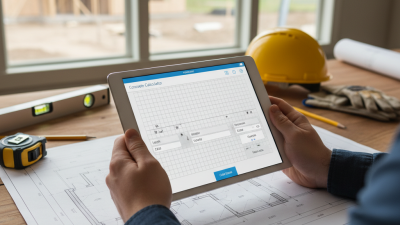
China Top Concrete Slab Calculator How Much Do I Need?
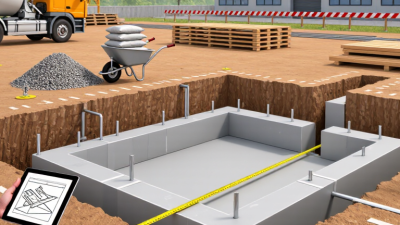
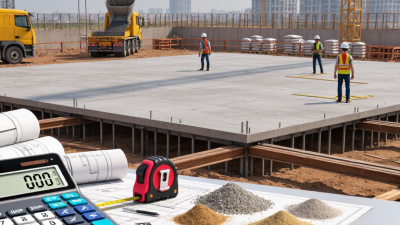
Planning a concrete slab in China starts with three measurements: length, width, and thickness. Enter them carefully, and check whether the calculator expects millimeters, centimeters, or meters. A concrete calculator slab tool can estimate the volume you need, often in cubic meters. That number helps with budgeting and ordering, but it is only as reliable as the measurements behind it.
For example, a 5-meter-by-4-meter slab with a 10-centimeter thickness needs about 2 cubic meters of concrete before any allowance for site conditions. Small gaps matter. Uneven ground, formwork movement, and spillage can change the amount required. Check twice. Consider adding a modest allowance, then confirm the final order with your supplier or contractor. Their advice may account for local delivery sizes and the mix specified for your project.
Thickness should match the slab’s intended use, ground conditions, and design requirements; a calculator cannot choose that for you. Measure the prepared area rather than relying on an old sketch, and keep all units consistent. Still, estimates are not promises. A neat result on screen can hide a rough base or a missed edge. Not quite certain? Recheck the dimensions before ordering, and seek qualified guidance when the slab carries substantial loads or forms part of a structural design.
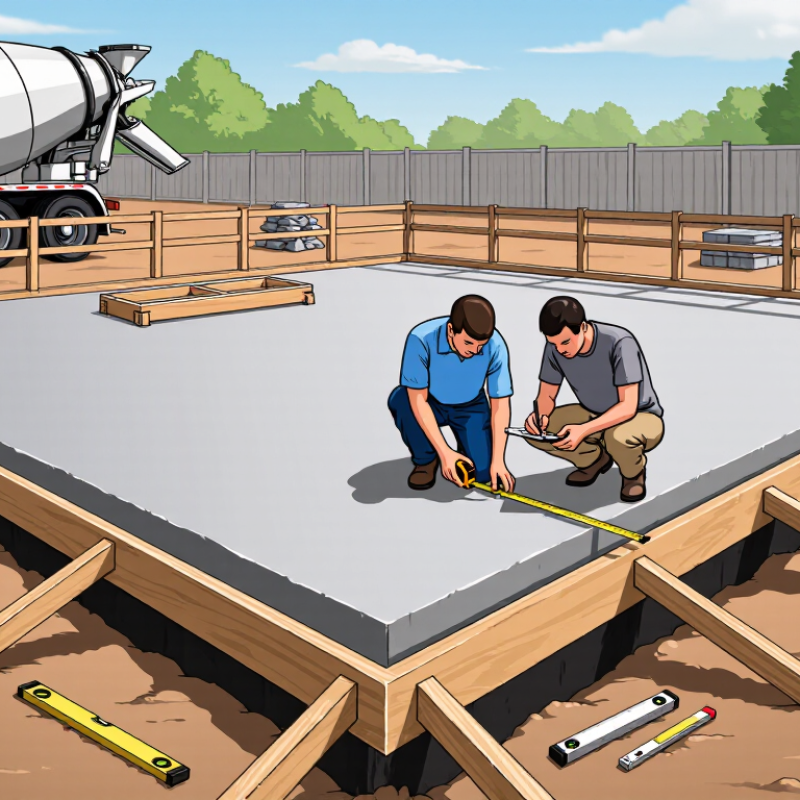
Measure the Slab’s Length, Width, and Thickness in Metres
Measure the slab’s length and width in metres, then record thickness in metres—not centimetres. For a rectangular slab, multiply length × width × thickness to get the required volume in cubic metres. A 6 m × 4 m slab, 0.12 m thick, needs 2.88 m³ before allowance for waste or uneven ground. Small errors matter. A thickness entered as 12 instead of 0.12 makes the estimate one hundred times too large. Check twice.
For an irregular shape, split the area into simple rectangles, calculate each volume, then add them. Measure thickness at several points, especially where the ground slopes; a single edge reading can understate the quantity. EN 206 classifies normal-weight concrete by density in the 2,000–2,600 kg/m³ range, a useful industry reference when checking concrete type, though density does not replace a volume calculation. The National Ready Mixed Concrete Association’s ordering guidance also stresses supplying an accurate quantity and clear job details. Include thickened edges or steps as separate volumes, and confirm a practical waste allowance with the installer. I still recheck the dimensions. That habit catches mistakes before ordering.
China Top Concrete Slab Calculator: How Much Do I Need? — Measure the Slab’s Length, Width, and Thickness in Metres
| Slab Project |
Length (m) |
Width (m) |
Thickness (m) |
Concrete Needed (m³) |
With 5% Allowance (m³) |
| Garden path |
10.0 |
1.0 |
0.075 |
0.75 |
0.79 |
| Small shed base |
3.6 |
2.4 |
0.10 |
0.86 |
0.91 |
| Patio |
4.0 |
3.0 |
0.10 |
1.20 |
1.26 |
| Residential driveway |
6.0 |
3.0 |
0.125 |
2.25 |
2.36 |
| Single-car garage floor |
6.0 |
5.0 |
0.15 |
4.50 |
4.73 |
| Workshop floor |
8.0 |
6.0 |
0.15 |
7.20 |
7.56 |
| Calculation: Length × width × thickness = concrete volume in cubic metres. The allowance adds 5% for minor measurement differences and placement waste. Confirm the required slab thickness and reinforcement with a qualified local professional for your site and intended use. |
Calculate Required Concrete Volume: Length × Width × Thickness (m³)
China Top Concrete Slab Calculator How Much Do I Need?
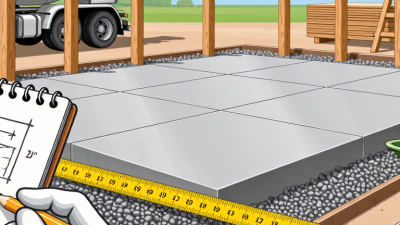
For a concrete slab, calculate volume in cubic metres: length × width × thickness. Measure all three dimensions in metres. Convert centimetres by dividing by 100; for example, 120 mm is 0.12 m. A slab measuring 5.2 m long, 3.4 m wide, and 0.12 m thick needs about 2.12 m³ before any allowance. The calculation is simple. Measuring accurately takes more care.
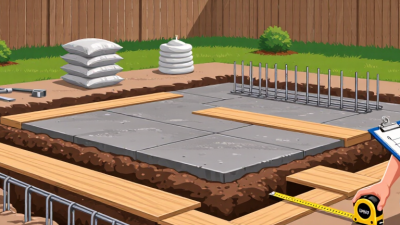
For an uneven outline, divide the area into rectangles, calculate each volume, then add them together. Include thickened edges or steps as separate shapes rather than assuming the slab has one uniform thickness. Check the base and formwork before ordering. Soft spots or bowed forms can affect the amount required. I recheck measurements because even a small thickness error applies across the whole slab. It is easy to overlook.
Tips: Keep measurements in metres and write them down before calculating. Consider a modest allowance for spillage or uneven forms, but confirm the order quantity with your concrete supplier or site professional. Don’t round down too early. The example’s 2.12 m³ is the calculated volume, not necessarily the final amount to order.
Concrete Slab Calculator: How Much Concrete Do I Need?
Required concrete volume = length × width × thickness. The chart shows example slab sizes and the volume required in cubic metres (m³).
Example: a 6 m × 4 m slab with a thickness of 0.125 m requires 3 m³ of concrete. These figures are calculated volumes and do not include extra material for waste or uneven ground.
Estimate Concrete Weight at About 2,400 kg/m³ for Normal-Weight Mix
China Top Concrete Slab Calculator: How Much Do I Need?
For normal-weight concrete, estimate about 2,400 kg/m³, or roughly 150 lb/ft³. ACI 213R, the American Concrete Institute’s guide to structural lightweight-aggregate concrete, uses approximately 150 lb/ft³ as a conventional-concrete reference. ASTM C138/C138M describes how fresh-concrete density is measured. Actual mix density can vary with aggregate, air content, and moisture.
Calculate slab volume in cubic metres: length × width × thickness. For example, a 10 m by 5 m slab, 12 cm thick, holds 6 m³ of concrete. At 2,400 kg/m³, its estimated concrete weight is 14,400 kg, or 14.4 tonnes. Check dimensions carefully; a small thickness error adds up across a large slab. This remains an estimate, not a batch ticket.
Tips
Convert centimetres to metres before calculating. Ask the supplier for the mix’s estimated density when accuracy matters. For a site measurement, use the ASTM C138/C138M test method.
Add a 5–10% Planning Allowance for Spillage and Uneven Ground
China Top Concrete Slab Calculator: How Much Do I Need?
Add a 5–10% Planning Allowance for Spillage and Uneven Ground
A concrete slab calculator estimates the volume from its length, width, and thickness. Measure the forms carefully, then keep all measurements in consistent units. For example, a 10-by-12-foot slab, 4 inches thick, needs about 1.48 cubic yards before any allowance. Add 5–10% for spills, small measurement errors, and uneven ground. That brings the estimate to roughly 1.55–1.63 cubic yards. It is a planning figure, not a guarantee.
Tips: Check the ground after excavation. A shallow dip can use more concrete than expected. Recheck slab thickness at several points, especially near the edges. Keep forms secure, and confirm the supplier’s ordering increments before placing an order. A very rough or sloped base may need more than a standard allowance.
The right buffer depends on preparation and site conditions. A compact, level base may need only a modest allowance; disturbed soil or irregular forms can raise demand. Don’t assume extra concrete can fix poor grading. I’d also avoid ordering exactly to the calculator’s minimum. It can look efficient on screen, but a short pour may leave an awkward cold joint or require a separate delivery. Check your measurements once more. Concrete volume adds up fast.
Check Slab Thickness and Reinforcement Against Applicable China Codes
A slab calculator estimates concrete volume: area multiplied by design thickness.
It cannot confirm whether the thickness is safe. In China, structural checks should follow the mandatory
General Code for Concrete Structures, GB 55008-2021,
alongside applicable design standards. Thickness depends on span, use, loads, support conditions, and subgrade quality.
A garage slab carrying vehicles is not equivalent to a lightly loaded patio.
Small differences matter.
Reinforcement needs the same care.
Bar diameter, spacing, concrete cover, anchorage, and placement all affect performance. The design must address bending, cracking, and durability, not just steel quantity. Construction acceptance is covered by
GB 50204-2015,
but acceptance checks do not replace structural design.
Have a qualified structural professional verify the project drawings and site conditions.
Soil can be uneven. That detail is easy to miss.
For industry context, China’s National Bureau of Statistics reported roughly
1.83 billion tonnes of cement production in 2024.
This is a market-scale figure, not a slab-design value. It cannot tell you the right thickness or reinforcement. A calculator may still feel reassuring, yet it can hide assumptions about loads and ground support.
Check those assumptions against the project’s applicable codes before ordering concrete.